Too many blogs and thought leader posts have anticipated, dissected, and pontificated about the highly anticipated silver tsunami coming for senior living. Guess what? That tsunami is here. Of the 67 million Boomers, every one of them will be 65 and older in just 4 years! The bad news? The Baby Boomer generation isn’t rushing to move into senior living communities. Your audience is already here, so why aren’t they connecting with you? Dr. Amanda Young points to AARP’s 2024 Home and Community Preferences Survey for the answer. That survey found 75% of adults aged 50 and older want to remain in their current home as they age. But Dr. Young believes a different approach to connecting with the 65+ audience, building a bridge to smoothly transition them into senior living is possible. And it’s a win-win for everyone bold enough to make her vision a reality.
Envisioning a Smarter Solution
With PhD and MS degrees in Gerontology and hands-on experience as a direct care aide, Dr. Young is an acknowledged expert on seniors, aging, and services for older adults. She understands their health and wellness needs as they age. And she knows just how strong their desire is to stay in their homes. She notes many older adults who want to age-in-place haven’t made a plan or have the financial resources to join a traditional CCRC or LifePlan Community. They frequently fail to fully grasp the realities of aging at home in terms of their future health and wellness needs. That’s one reason why she created MAL Consulting. In 2025, she realized there was an opportunity in the senior living industry to help non-profit organizations understand the advantages of reaching a wider, qualified audience who chooses to age in place. Making that a reality in the face of middle-income financial realities is possible with the continuing care at home model (CCaH).
The current landscape for home healthcare is an existing market that’s large, fragmented, and wildly inconsistent, according to Dr. Young. Consumers are left to piece together information on their own as their needs change. Worse, too often they must manage their own care coordination, source services from multiple providers, and deal with the epidemic of early discharge after hospitalizations. In a moment of crisis, all they can do is pray. But the Continuing Care at Home (CCaH) model offers a smart solution to the future problem that’s here today.
“CCaH,” Young says, “is not necessarily an either/or situation.” Instead, she advocates for creating a conduit which smoothly bridges the transition of its members into a senior living community. They begin with selected services and health and wellness benefits in home and on campus, meet and make new friends while dining on campus or working out, and ultimately, become full-time residents. “CCaH,” Dr. Young says, “is a natural partner, not a competitor to senior living.” And, CCaH can capture your audience’s attention by as much as 6-10 years earlier than a traditional independent living campaign.
Audience Insights
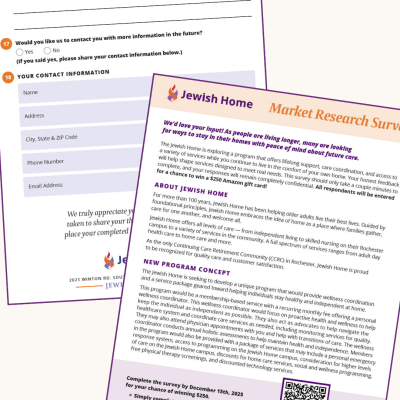 When MAL Consulting begins working with an organization, Amanda frequently begins with a feasibility and market study. Partnering with Sabal Strategy, age and income-qualified data provides an audience for a digital and print survey. A recent client, Jewish Home of Rochester, commissioned such a survey. They sent out 25,000 mailers and were amazed at the result. Their response rate was 2 times the industry average, and they had to increase their postal account twice to keep up.
Surveys are a goldmine of valuable information. In this case, they learned most respondents, ages 65 to 69 years old, prioritized access to quality care, an ability to remain independent, and to retain control of their lives and care. Ability to access on-campus amenities were neither top-of-mind nor a dealbreaker. The survey gave their client critical insights, including:
- how familiar their audience was with the organization,
- price sensitivities,
- whether this audience was planning for their future care needs
- their current situation and solutions
In other words, they understood the key barriers to concept acceptance they needed to overcome in order to convert this qualified audience.
CCAH: A Winning Solution
Armed with the data from a survey, Amanda helps each organization develop a custom model for their community. She does not believe in cookie-cutter solutions. She recognizes the preference of Boomers to carve a unique path in their later life just like the independence they enjoyed in their youth. Based on what they’ve learned, each community builds a CCaH model with custom menu and pricing options that reflects their community.
Dr. Young also works with organizations that have a CCaH model in need of help to fully succeed. Whether they’re new to the concept and need to educate their Board of Directors or have a model in place, Dr. Young brings her expertise to find the right solutions for each client.
Retirement Without Walls
In many ways, Dr. Young and MAL Consulting honors the memory of her mother. Her early life experiences with a mother who was a nurse, the heart of her community, and a love for older adults helped to build a deep empathy and passion for helping seniors. So helping nonprofit organizations build a retirement community without walls for their local audience is a natural path in her life.
If you’re interested in CCaH and how your organization can join this movement, Dr. Young is the right person to contact. Sabal Strategy is proud to partner with and support this entrepreneur. Maribeth Jenkins, CEO of Sabal, calls CCaH a brilliant idea offering great synergy and support for CCRCs. We hope your leadership team considers the value in moving outside the walls to build a community off campus.
Dr. Amanda Young is an applied gerontologist and executive-level nonprofit leader with more than 20 years experience in aging services. Over the course of the past 10 years, she has successfully launched and operated Continuing Care at Home programs in Maryland, Pennsylvania, and South Carolina. Dr. Young earned her Ph.D. in Leadership and Gerontology from Concordia University Chicago; her dissertation was a qualitative analysis of the wellness coordination model of CCaH programs. She earned a Masters of Science in Gerontology from McDaniel College. She is a speaker at national conferences and has been published by McKnight’s Senior Living and Long-Term Care News. She also partners with LeadingAge LTSS Research Center to collect CCaH industry benchmarking data and is a presenter at the LeadingAge CCaH virtual conference annually. Dr. Young is an Adjunct Professor in the graduate program of gerontology and thanatology at the University of Maryland Baltimore.